The coach behind the app
Meet Jesse Teron
Former captain of the UVic Vikes, and the voice behind every score, verdict and drill in Hit It Pure.
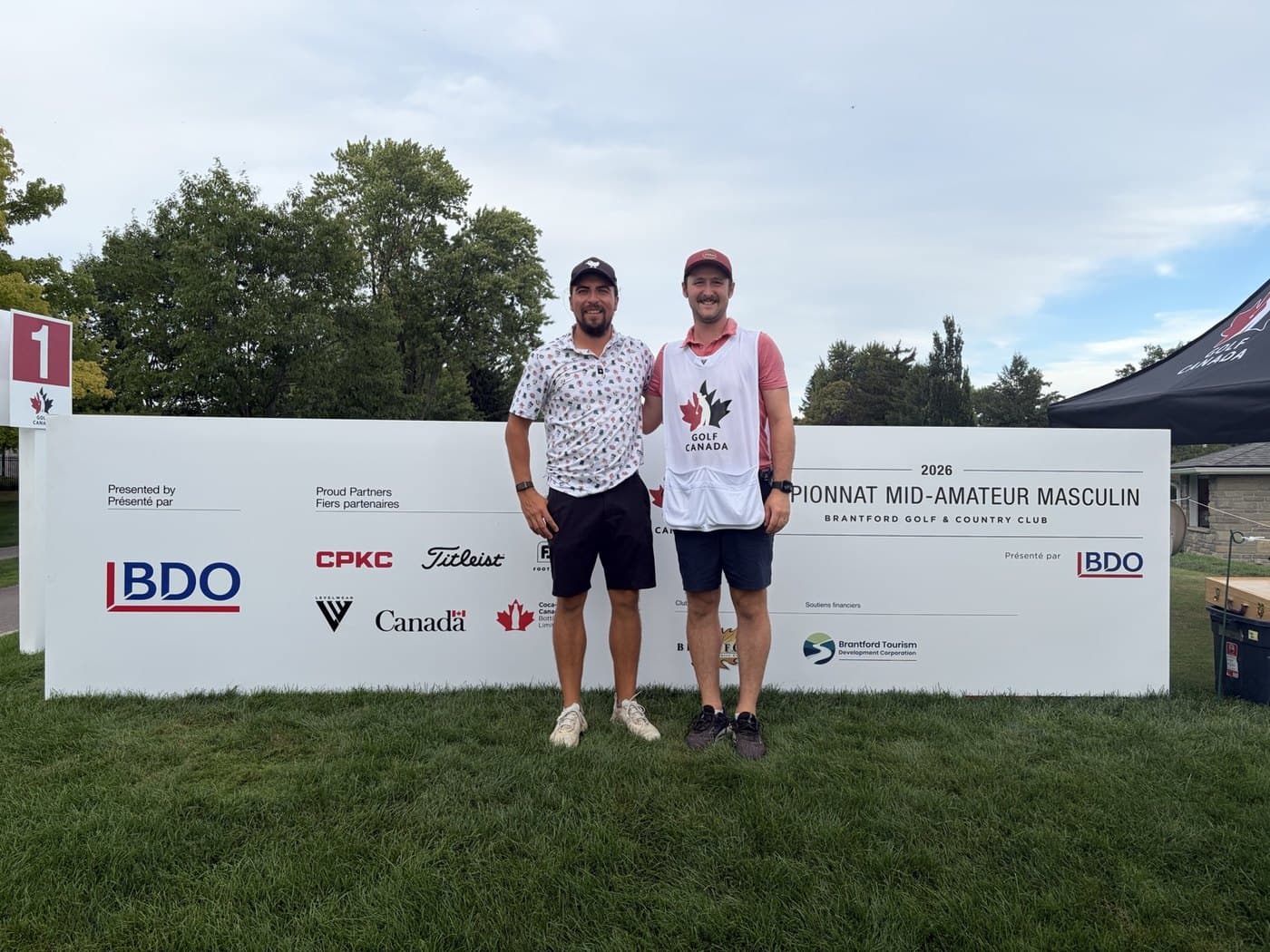
Captain of the Vikes
Jesse played his university golf at the University of Victoria, where he captained the Vikes. Captaining a university side is a different job from being its best player. You spend your season watching teammates swing, working out why a good player is suddenly losing it right, and finding the one thing to say on the range before a counting round that actually helps.
That is the habit this whole app is built on. Not a library of every tip in golf — the discipline of looking at a swing, deciding what matters most right now, and saying only that.
Jesse still competes. The photo above is from the Canadian Men’s Mid-Amateur Championship at Brantford Golf & Country Club, one of the strongest amateur fields in the country.
Where the coaching comes from
Every checkpoint the app measures, every verdict it gives you and every drill it prescribes comes from Jesse, drawing on the teaching of hundreds of PGA professionals — the coaches he has worked with, played under and learned from.
That matters because the AI is doing measurement, not judgement. The model reads your body position frame by frame and turns it into numbers. What those numbers should be, which of them costs you the most shots, and what to do about it — that is coaching, and it is Jesse’s.
- Hip Hinge
- Knee Bend
- Arm Hang
- Takeaway Width
- Shaft Plane
- Hand Depth
- Top Position
- Shoulder Turn
- Head Stability
- Posture Retention
- Tempo
- Impact Posture
The 12 positions Jesse grades — each with a target range and a drill behind it.
How the numbers were set
A score of 6.2 means nothing unless you know what decided it. Every checkpoint has a target range, every range has a reason, and every reason is graded by how good the evidence behind it actually is — including the ones where the honest answer is “this is what coaches say and we could not find a measurement behind it”. That is a perfectly good basis for a target. Pretending it is a measurement is not.
- Hip Hingetarget 28–40 °
- Standard setup instruction: roughly 28-40° of forward tilt from the hips, taken from the spine angle between shoulders and hips.
- Standard instruction, no measured source found
- What’s wrong with it: No population measurement of address hinge was found with a stated mean and spread, so the band is the instructional convention rather than a distribution. Forward tilt is, however, the one golf quantity a single camera has been shown to read usefully — see Yamamoto.
Yamamoto et al. (2023), Extracting proficiency differences using single-video markerless motion analysis — n=27 golfers, single camera, sagittal, 240Hz. Trunk forward-tilt CONSISTENCY correlated with proficiency (r=0.801). The nearest thing in the literature to what this app does — and it used 240fps and reported no absolute accuracy.
- Knee Bendtarget 155–172 °
- Athletic-setup convention — soft but not squatting, measured as the hip-knee-ankle angle.
- Standard instruction, no measured source found
- What’s wrong with it: Knee angle is among the better-measured joints from a single camera, but published RMSE against optical mocap still runs 15-29° depending on where the camera stood. The band is wider than the instruction to reflect that.
Baldinger, Reimer & Senner (2025), Influence of the Camera Viewing Angle on OpenPose Validity — Joint-angle RMSE vs Vicon: knee 15.5-29.4 deg, hip 15.2-25.3, elbow 29.4-37.1, shoulder 23.6-36.5 — depending on where the camera stood. Camera placement moves the answer by 10-14 deg.
- Arm Hangtarget 0–18 % torso
- Arms hanging under the shoulder sockets, measured as the horizontal offset of the lead wrist from the lead shoulder.
- Standard instruction, no measured source found
- What’s wrong with it: A coaching rule with no measured source found behind it. It is read across the shoulder line, so it no longer depends on where the camera stood — but that projection uses the depth axis, which is the least trustworthy output of the pose model.
Grishchenko, Bazarevsky et al. (2022), BlazePose GHUM Holistic — The pose model this app runs. World landmarks are metres from the hip centre; the depth axis is fitted against an assumed body model rather than measured, and no metric depth accuracy is published.
- Takeaway Widthtarget 95–135 % torso
- One-piece takeaway: the hands stay out in front of the chest rather than working inside early.
- Standard instruction, no measured source found
- What’s wrong with it: Instructional convention. No measured distribution found.
- Shaft Planetarget -8–8 °
- Club parallel to the target line when the lead arm is horizontal. Estimated from the lead forearm — this build does not track the club itself.
- Our own reasoned default
- What’s wrong with it: The weakest number in the app, and the one to fix first. The club is not a pose landmark at all, so this is a forearm proxy; and at 30fps a clubhead travelling 50m/s smears across most of the frame, so tracking it properly needs both a separate detector and a much higher frame rate than a phone's default. It is at least camera-independent now: it took the forearm's horizontal length as its x component alone, which meant a forearm pointing at the lens — the normal case down the line, where this checkpoint applies — read as 90 degrees off horizontal.
Grishchenko, Bazarevsky et al. (2022), BlazePose GHUM Holistic — The pose model this app runs. World landmarks are metres from the hip centre; the depth axis is fitted against an assumed body model rather than measured, and no metric depth accuracy is published.
- Hand Depthtarget 20–55 % torso
- Depth at the top as the precondition for an in-to-out path; shallow hands as the classic over-the-top marker.
- Standard instruction, no measured source found
- What’s wrong with it: Measured along the target line rather than along the camera's x axis, so it no longer changes when the camera moves — but it is still read largely through the depth axis, which BlazePose fits against an assumed body model rather than measures. Treat as a direction of travel for one golfer over time, not as a number to compare between golfers.
Grishchenko, Bazarevsky et al. (2022), BlazePose GHUM Holistic — The pose model this app runs. World landmarks are metres from the hip centre; the depth axis is fitted against an assumed body model rather than measured, and no metric depth accuracy is published.
- Top Positiontarget 88–118 % of head height
- Hand height at the top relative to head height, bounded to exclude both a short backswing and an overswing.
- Standard instruction, no measured source found
- What’s wrong with it: Instructional convention. Measured in the image plane, which is the part a single camera reads best.
- Shoulder Turntarget 80–105 ° of turn
- Degrees of shoulder rotation about the vertical axis between address and the top, measured from 3D world landmarks. A full turn is conventionally put near 90°, and the 80-105° band is set around that.
- Standard instruction, no measured source found
- What’s wrong with it: The highest-risk measurement in the app, for three compounding reasons. It is almost entirely a depth-axis quantity, and depth is the least validated output of the pose model. The shoulder landmarks sit on the deltoid and move with the arms, so they are not the thorax — marker-based studies mount a rigid chest cluster for exactly this reason. And the related X-factor literature finds that different computation methods give significantly different answers from the same capture, and that within scratch golfers the number does not relate to clubhead speed at all. Useful as a change within one golfer filmed the same way twice; not as an absolute compared against a tour figure. When depth is unavailable entirely the checkpoint is now withheld rather than graded: the image-space fallback is a projected shoulder-width ratio, capped at 90 degrees by construction and meaningless down the line, and grading it against a rotation band read 62.9 on frames that measured 94.8 with depth.
Myers et al. (2008), The role of upper torso and pelvis rotation in driving performance — n=100 recreational golfers, 8 optical cameras at 200Hz. Torso-pelvis separation at the top 44.2±7.7 deg (low ball speed) to 59.1±8.2 (high). Upper-torso rotation itself did NOT differ between groups — only the separation did.
Kwon et al. (2013), Validity of the X-factor computation methods — n=18 skilled golfers (handicap -0.6±2.1), 250Hz optical. Different computation methods give significantly different values, and within scratch golfers the X-factor parameters did not relate to clubhead speed at all.
Grishchenko, Bazarevsky et al. (2022), BlazePose GHUM Holistic — The pose model this app runs. World landmarks are metres from the hip centre; the depth axis is fitted against an assumed body model rather than measured, and no metric depth accuracy is published.
- Head Stabilitytarget 0–12 % torso off address at impact
- Head position at impact relative to address, normalised by torso length — whether the head came back, not how far it went.
- Peer-reviewed measurement
- What’s wrong with it: This measured the drift across the whole swing until the evidence was checked, and the evidence says that is backwards. The one direct measurement of head motion in golfers found elites move the head about twice as far as novices, and that what both groups do is return it: the chin comes back to within a centimetre of its address position at impact. A golfer who sways off the ball and returns was being marked down for doing the thing good players do. Two remaining weaknesses: no published head-displacement norms relative to address exist for any population, so the band is inferred rather than fitted; and the measurement is against the body, so a golfer sliding their whole lower body moves head and hips together and can still read as steady.
Sanders & Owens (1992), Hub Movement During the Swing of Elite and Novice Golfers — n=6 elite (handicap 0-5) and 6 novice, 200Hz video. Elite chins travel about twice as far as novices — 18.2cm forward in the downswing alone — and BOTH groups return the chin to within a centimetre of its address position at impact. The authors recommended abandoning 'keep your head still' as a coaching cue.
Wrobel, Marclay & Najafi (2012), Golfing skill level postural control differences — n=18. Advanced players showed 57-73% less centre-of-mass displacement RELATIVE TO ADDRESS at peak arm speed. Displacement measured against address, at a moment — which is how this app now measures head position.
- Posture Retentiontarget 0–7 ° of change
- Early extension: the change in spine tilt between address and impact.
- Standard instruction, no measured source found
- What’s wrong with it: In-plane, large in magnitude and measured at two quasi-static instants — the most favourable combination there is for a single camera, and probably the most trustworthy angle in the report. One caution worth knowing: elite golfers lose about 19 degrees of PELVIC forward bend from address to impact while holding thoracic forward bend to within about 2 degrees, so pelvic extension is normal and thoracic extension is the fault. This reads the shoulder-to-hip line, which is closer to the thoracic measure, but the two are not cleanly separable from these landmarks. Note also that the term 'early extension' does not appear as a measured variable anywhere in the peer-reviewed literature, and no published threshold exists at which posture loss becomes a fault — the widely quoted TPI prevalence figure carries no method, sample or citation.
Wheare et al. (2021), Reliability and Validity of the Polhemus Liberty System for Elite Golfers — n=15 elite, Vicon criterion. Elites lose about 19 deg of PELVIC forward bend from address to impact while holding THORACIC forward bend to within about 2 deg. Also found 10-38 deg of disagreement between two measurement systems on the same swings, which is why absolute angle thresholds do not travel between studies.
Chu, Sell & Lephart (2010), The relationship between biomechanical variables and driving performance — n=308, handicap 8.4±8.4, 240Hz optical plus force plates. Lead-knee flexion at impact 16.2±9.4 deg — an SD well over half the mean — and it did NOT survive as a predictor of ball velocity. Trunk forward tilt held near 22-24 deg through the downswing and its coefficient GREW toward impact.
Yamamoto et al. (2023), Extracting proficiency differences using single-video markerless motion analysis — n=27 golfers, single camera, sagittal, 240Hz. Trunk forward-tilt CONSISTENCY correlated with proficiency (r=0.801). The nearest thing in the literature to what this app does — and it used 240fps and reported no absolute accuracy.
Baldinger, Reimer & Senner (2025), Influence of the Camera Viewing Angle on OpenPose Validity — Joint-angle RMSE vs Vicon: knee 15.5-29.4 deg, hip 15.2-25.3, elbow 29.4-37.1, shoulder 23.6-36.5 — depending on where the camera stood. Camera placement moves the answer by 10-14 deg.
- Tempotarget 2.5–3.5 :1 back-to-through
- Backswing-to-downswing ratio. Tour professionals measured at 250Hz cluster between 2.5:1 and 3.5:1, averaging near 3.0, which is the band used here.
- Published, not peer-reviewed
- What’s wrong with it: The best-evidenced band in the table, and still narrower than the evidence supports. Two things are usually got wrong about it. The famous 3:1 comes from counting frames of 30fps video, where integer frame counts can only land on 3.0 — the precision is an artefact. And amateur group means are also near 3.0: what separates a tour player is the swing-to-swing consistency, not the average. Grober's amateurs differ mainly in downswing SPEED, which is a strength variable, so telling a high handicapper to speed up their backswing to reach 3:1 solves the wrong thing. The one published test of whether swing timing predicts dispersion found it did not.
Grober & Cholewicki (2006), Towards a Biomechanical Understanding of Tempo in the Golf Swing — 250Hz shaft accelerometers, 5-iron; n=12 playing professionals, 13 teaching pros/good amateurs, 18 recreational. Pros cluster at 2.5-3.5, averaging near 3.0.
Grober (2009), An Accelerometer Based Instrumentation of the Golf Club — Same 250Hz rig. Per-golfer means: PGA pro 724±23ms back / 248±4ms down (2.92:1); 10-handicap 817/385 (2.12:1); 25-handicap 830/433 (1.92:1). Backswing time barely varies with skill — the ratio difference is almost all downswing.
Novosel (2004), Tour Tempo — The origin of 3:1, measured by counting frames of 30fps broadcast video. Every reported ratio is exactly 3.0, which at integer frame counts is a quantization artefact rather than a finding.
Neal et al. (2007), Body Segment Sequencing and Timing in Golf — n=25 elite amateurs. Mistimed shots had 2.5x the lateral dispersion of well-timed ones, yet showed NO significant difference in any timing lag or peak segment speed. The direct test of timing against dispersion, and it came out negative.
- Impact Posturetarget 155–178 ° lead-leg extension
- Lead-leg extension at impact as the marker of posting up and compressing the ball.
- Peer-reviewed measurement
- What’s wrong with it: Graded deliberately loosely, because the measurement does not support a tight band. Across 308 golfers spanning the handicap range, lead-knee flexion at impact is 16.2 +/- 9.4 degrees — an SD well over half the mean — and it did not survive as a predictor of ball velocity in that regression. The lead-knee variable that DID have a real coefficient was flexion at the top of the backswing, where more was better. On top of that it is read at a single frame during the fastest part of the swing, which is where markerless pose is least reliable. Worth showing a golfer; not worth grading tightly.
Chu, Sell & Lephart (2010), The relationship between biomechanical variables and driving performance — n=308, handicap 8.4±8.4, 240Hz optical plus force plates. Lead-knee flexion at impact 16.2±9.4 deg — an SD well over half the mean — and it did NOT survive as a predictor of ball velocity. Trunk forward tilt held near 22-24 deg through the downswing and its coefficient GREW toward impact.
Baldinger, Reimer & Senner (2025), Influence of the Camera Viewing Angle on OpenPose Validity — Joint-angle RMSE vs Vicon: knee 15.5-29.4 deg, hip 15.2-25.3, elbow 29.4-37.1, shoulder 23.6-36.5 — depending on where the camera stood. Camera placement moves the answer by 10-14 deg.
And what we adjust them for
A fixed target grades everyone against one imaginary golfer. These are the shifts applied on top of the ranges above, and why.
- Club — hip hinge
- A driver is played from a more upright setup than a wedge. Standard instruction puts roughly 8° of hip hinge between the two extremes, applied as -4° for a driver through +4° for a wedge, with a mid iron as the baseline.
- Club — swing length and turn
- Wedges are swung deliberately shorter for control, so hand height and shoulder turn bands drop for the short clubs (-12 at a wedge) and rise slightly for a driver. The magnitudes are estimates chosen to stop a controlled wedge swing being graded as a short backswing.
- Height — hip hinge
- Taller golfers hinge further to reach the ball. Applied as 1.5° per 10cm away from a 178cm baseline, capped at 4°. The gradient is an estimate.
- Mobility — shoulder turn
- A golfer whose back or hips restrict their turn cannot reach a 90° band and should not be graded as failing. Shifts the turn band down 15° and widens the tolerance by 10° on a self-reported limitation. Both numbers are estimates.
- What’s wrong with it: This adjustment exists so a golfer is not marked down for the body they have. It is NOT a performance claim, and the evidence is against reading it as one. A meta-analysis of 20 studies found flexibility essentially unrelated to clubhead speed (z_r = -0.04, 95% CI -0.33 to 0.26) while jump impulse and strength were strongly related; and a study measuring clinical hip range of motion and in-swing hip rotation in the same golfers found a 20° clinical deficit produced only a non-significant 8° difference in what the joint actually did during the swing. A self-reported limitation is a weaker signal still. Treat it as a fairness adjustment with a guessed magnitude.
3 of 12 ranges rest on a published measurement; the rest are standard instruction. None has yet been signed off by name by Jesse or the coaches we work with — when one has, it will say so here.
What one phone camera can and can’t measure
There is no published study validating single-camera body tracking against marker-based motion capture for a golf swing. Anyone claiming validated accuracy from a phone is claiming something nobody has established — so here is where we think the line is.
We measure this
- Swing phase detection — address, takeaway, top, impact, finish. This is classification, not measurement, and it survives the systematic bias that degrades absolute angles.
- In-plane angles held at a quasi-static instant: hip hinge and knee flex at address, spine tilt. Published single-camera error for proximal in-plane angles runs roughly 3-8°.
- Trunk forward tilt from down the line, which is the one golf quantity a single camera has been shown to read usefully.
- Change within one golfer, filmed the same way twice. Most of the error is systematic bias rather than random noise, and systematic bias largely cancels in a comparison.
- Consistency across repetitions, for the same reason.
We refuse to
- Anything about the club — path, face, shaft plane, clubhead speed. The club is not a pose landmark, and at 30fps a clubhead is a streak across the frame rather than an object.
- Absolute axial rotation in degrees, including X-factor. It is a depth-axis quantity read from a fitted depth estimate, and the published methods disagree with each other.
- Wrist angles. Distal joints are the worst-measured in every study, and the hands self-occlude and blur.
- Peak angular velocities and the ordering of the kinematic sequence. The gaps are tens of milliseconds; a 30fps frame is 33.
- Any injury or clinical claim. Published consensus is that markerless joint angles are not yet accurate enough for clinical use, and that framing changes what the product legally is.
- Grading every golfer against one template. Two published weight-transfer styles — one of which coaching calls a reverse pivot — have identical handicaps and identical clubhead speed, occur at every skill level, and have inverted performance correlates. Coaching one toward the other may be actively wrong.
Everything we read
- Baldinger, Reimer & Senner (2025), Influence of the Camera Viewing Angle on OpenPose Validity
- Ball & Best (2007), Different centre of pressure patterns within the golf stroke
- Chu, Sell & Lephart (2010), The relationship between biomechanical variables and driving performance
- Grishchenko, Bazarevsky et al. (2022), BlazePose GHUM Holistic
- Grober (2009), An Accelerometer Based Instrumentation of the Golf Club
- Grober & Cholewicki (2006), Towards a Biomechanical Understanding of Tempo in the Golf Swing
- Kwon et al. (2013), Validity of the X-factor computation methods
- Myers et al. (2008), The role of upper torso and pelvis rotation in driving performance
- Neal et al. (2007), Body Segment Sequencing and Timing in Golf
- Novosel (2004), Tour Tempo
- Sanders & Owens (1992), Hub Movement During the Swing of Elite and Novice Golfers
- Tinmark et al. (2010), Elite golfers' kinematic sequence in full-swing and partial-swing shots
- Wheare et al. (2021), Reliability and Validity of the Polhemus Liberty System for Elite Golfers
- Wrobel, Marclay & Najafi (2012), Golfing skill level postural control differences
- Yamamoto et al. (2023), Extracting proficiency differences using single-video markerless motion analysis
One to one
Ask Jesse to coach me
The app will tell you what to fix. Sometimes you want the person who wrote it watching you hit balls. Book an hour with Jesse and work on it together.
Not ready for a lesson yet?
Upload a swing and get Jesse’s read on it in about four seconds, free.
Analyze my swing